 Mukesh1@gmail.com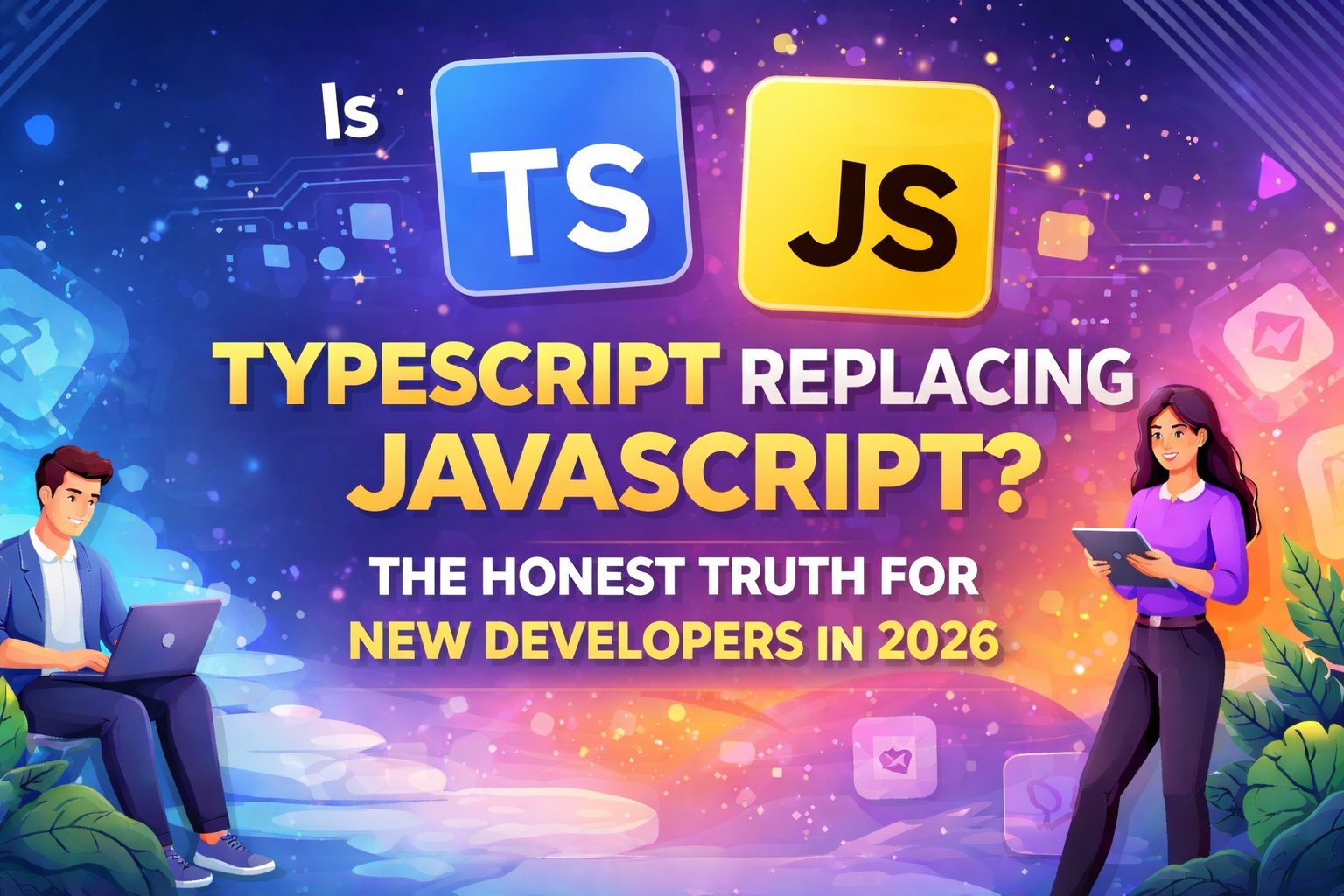
Introduction
Every few months, this question surfaces in developer forums, Reddit threads, and beginner communities — is TypeScript replacing JavaScript? It’s not a silly question at all. If you’re new to web development and you see major frameworks recommending TypeScript, job listings mentioning it, and experienced developers talking about it constantly, it genuinely looks like JavaScript might be getting replaced by something newer and better.
The short answer is no — Is TypeScript replacing JavaScript is a misconception that comes from a misunderstanding of what TypeScript actually is. But the full picture is more nuanced than a simple yes or no. TypeScript has changed how the industry writes JavaScript code, and understanding that relationship matters a lot when you’re deciding what to learn and in what order. This guide explains everything clearly, without hype in either direction, so you can make an informed decision about your learning path in 2026.
What TypeScript Actually Is – And What It Isn’t
Before answering whether is TypeScript replacing JavaScript, you need to understand the fundamental relationship between the two.
TypeScript is not a separate language that competes with JavaScript. It is a superset of JavaScript — meaning every valid JavaScript program is also a valid TypeScript program. TypeScript simply adds a type system on top. It lets you declare what kind of data your variables hold, what a function expects as input, and what it returns.
Here’s a simple comparison:
// Plain JavaScript
function greetUser(user) {
  return `Hello, ${user.name}`;
}

// TypeScript — with type annotations
function greetUser(user: { name: string; age: number }): string {
  return `Hello, ${user.name}`;
}
The TypeScript version makes explicit what the JavaScript version only implies. If you try calling that function with the wrong type of data, TypeScript catches it before your code even runs.
But here is the most important part: TypeScript compiles away. When TypeScript runs, a compiler strips out all type annotations and produces plain JavaScript. Browsers never see TypeScript. Node.js doesn’t run TypeScript natively. What actually executes at the end is JavaScript.
So when people ask is TypeScript replacing JavaScript, the answer is: it can’t replace JavaScript, because TypeScript becomes JavaScript before it runs.
Why TypeScript Became So Popular – The Real Reasons
Understanding why the industry embraced TypeScript helps clarify whether the question of is TypeScript replacing JavaScript is even the right question to ask.
JavaScript Gets Complicated at Scale
JavaScript was designed for small scripts that added interactivity to web pages. Its flexibility — loosely typed, dynamic, forgiving — works perfectly at small scale. But as applications grew to hundreds of files, dozens of contributors, and thousands of functions, that same flexibility created problems.
When a codebase is large, knowing what type of data a function expects becomes genuinely important. Without types, you rely on outdated documentation, inconsistent naming conventions, or reading through the implementation itself. Errors that would be obvious with type checking — passing a string where a number is expected, accessing a property that doesn’t exist — only appear at runtime when a user hits the right code path.
TypeScript solves this at the tooling level. Its type system allows your editor to know what properties an object has, what arguments a function accepts, and what a method returns. That means real autocomplete, error highlighting before running code, and refactoring tools that update every correct reference automatically.
The Framework Ecosystem Moved Toward TypeScript
Angular adopted TypeScript early, placing it in front of a large portion of enterprise developers. React’s ecosystem built strong TypeScript support. Vue 3 was rewritten in TypeScript. Next.js, Nuxt, and SvelteKit all provide first-class TypeScript support.
The DefinitelyTyped project grew to cover tens of thousands of JavaScript libraries with type definitions. At this point, not using TypeScript in a large professional project is the choice that requires justification — not the other way around.
This context helps answer is TypeScript replacing JavaScript more accurately: it hasn’t replaced JavaScript, but it has become the standard professional layer on top of JavaScript.
What the Numbers Actually Show
The Stack Overflow Developer Survey consistently shows TypeScript among the most loved and most widely used languages. The State of JS survey shows TypeScript usage climbing year over year. These are real, significant numbers.
But here’s what the numbers also show — JavaScript itself has not declined. TypeScript’s growth is additive. More developers are using TypeScript in addition to JavaScript, not instead of it. JavaScript remains the most widely used programming language in web development by a substantial margin.
This is the clearest data-based answer to is TypeScript replacing JavaScript: no. TypeScript usage is growing, but JavaScript usage is not shrinking. Every TypeScript developer is also writing JavaScript — TypeScript is simply JavaScript with a type annotation layer applied during development.
The Case for Learning JavaScript First
If you’re a new developer in 2026, the most practical version of the question is: what should I learn first?
The answer is still JavaScript first, and the reasons are solid.
TypeScript Requires JavaScript Understanding to Make Sense
TypeScript’s entire value is in annotating JavaScript with types. If you don’t understand JavaScript’s data types, object structures, functions, and runtime behavior, TypeScript annotations mean nothing to you. You’d be adding syntax you don’t understand to describe behavior you haven’t yet learned.
When TypeScript throws a type error, understanding it requires understanding the underlying JavaScript. When you need to type a complex function, you need to understand what that function is doing with JavaScript’s data structures first. Asking is TypeScript replacing JavaScript from a beginner’s perspective misses this — TypeScript teaches nothing on its own that JavaScript doesn’t teach first.
JavaScript Needs Zero Setup to Start
One of the genuine advantages of learning JavaScript is immediate feedback. Open a browser, open the developer console, start writing code. No compiler, no configuration file, no package manager, no build step.
TypeScript requires compilation. Setting up a TypeScript project means installing Node.js, configuring a tsconfig.json, and running a build process. For someone learning programming fundamentals, that overhead is pure friction with no learning benefit.
// This runs immediately in any browser console — zero setup needed
const numbers = [1, 2, 3, 4, 5];
const doubled = numbers.map(n => n * 2);
console.log(doubled); // [2, 4, 6, 8, 10]
That immediacy is genuinely valuable when you’re still learning the basics.
The Case for Learning TypeScript – And When It Makes Sense
Is TypeScript replacing JavaScript as a priority for new learners? Not replacing, but it’s becoming harder to ignore. Here’s why TypeScript matters and when to add it to your learning.
The Job Market Expects It
For most mid-level and senior developer roles, TypeScript knowledge is expected rather than optional. If professional web development is your goal, TypeScript isn’t something you can defer indefinitely. The practical timeline for most beginners — build JavaScript fundamentals for several months, then add TypeScript when working on larger projects or preparing for job applications — makes the transition natural and manageable.
TypeScript Makes You a More Careful JavaScript Developer
Even setting aside tooling benefits, learning TypeScript changes how you think. When you’re required to state explicitly what type of data a function accepts and returns, you start reasoning about data flow more carefully. That habit of mind doesn’t disappear when you write plain JavaScript later.
Developers with real TypeScript experience often write better-structured JavaScript even in codebases that don’t use it — because thinking in types and contracts is now part of how they approach problems.
Modern Frameworks Are TypeScript-First
React, Next.js, Angular, Vue 3, SvelteKit — the default project templates and official documentation for all of these are now TypeScript. Engaging with these frameworks means engaging with TypeScript. Here’s what a typed React component looks like:
// React component with TypeScript — standard in real projects
interface UserCardProps {
  name: string;
  email: string;
  avatarUrl?: string; // optional
}

function UserCard({ name, email, avatarUrl }: UserCardProps) {
  return (
    <div className="user-card">
      {avatarUrl && <img src={avatarUrl} alt={name} />}
      <h3>{name}</h3>
      <p>{email}</p>
    </div>
  );
}
Reading this comfortably is the realistic goal for anyone aiming at professional React development.
One Important Recent Development You Should Know About
There’s a genuine 2025–2026 development worth understanding when thinking about is TypeScript replacing JavaScript.
A TC39 proposal for Type Annotations in JavaScript — sometimes called “types as comments” — would allow JavaScript itself to include TypeScript-style type annotations that the JavaScript engine simply ignores at runtime. These types would only be useful to editors and type-checking tools.
If this proposal advances, you could write:
// Possible future JavaScript — types ignored at runtime, no compiler needed
function greetUser(user: { name: string }): string {
  return `Hello, ${user.name}`;
}
And it would run as valid JavaScript with no build step. This signals how influential TypeScript’s syntax has become — the JavaScript specification itself is considering incorporating TypeScript’s annotation style natively.
Whether this makes it into a final ECMAScript version remains to be seen. But it answers is TypeScript replacing JavaScript in a new way: TypeScript’s ideas may eventually become part of JavaScript itself. You can follow this proposal’s progress through the official TC39 proposals repository on GitHub.
A Realistic Learning Path for Beginners in 2026
Based on everything above, here’s what a practical, sensible path looks like — one that takes is TypeScript replacing JavaScript seriously without overreacting to it.
Months 1–4: Learn JavaScript properly. DOM manipulation, functions, arrays, objects, asynchronous code, the Fetch API, core ES6+ features. Build real things — interactive pages, small applications, simple browser-based tools. Don’t rush this stage.
Months 4–8: Add TypeScript alongside a framework. Pick React or Vue, follow the TypeScript-flavored official documentation, and get comfortable with basic type annotations, interfaces, and typed component props. You’ll find the transition smoother than expected.
Ongoing: Go deeper as you encounter real problems. Generics, utility types, complex interface patterns — these make sense progressively as you encounter the problems they solve in actual code.
This path doesn’t treat TypeScript as something to avoid or defer indefinitely. It treats it as a natural next layer once the JavaScript foundation is solid. TypeScript’s official documentation has an excellent section specifically written for developers coming from JavaScript — it’s worth bookmarking when you’re ready. The TypeScript for JavaScript Programmers guide is one of the cleaner official learning resources available.
For beginners still building their JavaScript base, resources like the MDN JavaScript Guide remain the most reliable reference for language fundamentals. You might also find our guide on the best JavaScript online courses for beginners in 2026 helpful for choosing where to start.
Common Misconceptions About Is TypeScript Replacing JavaScript
A few things beginners often believe that aren’t quite accurate:
“TypeScript is faster than JavaScript.” Not true. TypeScript compiles to JavaScript and runs at exactly the same speed. Type annotations are removed before execution. TypeScript has no runtime performance benefit.
“You need TypeScript to get a job.” For entry-level roles, strong JavaScript fundamentals matter more. TypeScript becomes more important at mid-level and above. Starting with it too early before JavaScript is solid often leads to confusion.
“TypeScript is a completely different language.” It isn’t. It’s JavaScript with added syntax. Any JavaScript developer can start reading TypeScript immediately — the new parts are the type annotations, and those follow clear, learnable rules.
“All TypeScript errors are JavaScript bugs.” TypeScript’s type errors are tooling warnings, not runtime errors. TypeScript helps you catch potential problems before running code — it doesn’t tell you your JavaScript is broken, it tells you there’s a type inconsistency worth checking.
Final Conclusion
Is TypeScript replacing JavaScript? The complete, honest answer is no — not in any fundamental sense. TypeScript is built on JavaScript, compiles to JavaScript, and requires JavaScript understanding to use meaningfully. What TypeScript has done is become the professional standard layer on top of JavaScript for most serious web development work.
For new developers in 2026, the right relationship with TypeScript isn’t anxiety about whether to learn it or ignore it — it’s clarity about when. JavaScript fundamentals come first. Not because TypeScript isn’t important, but because TypeScript only becomes valuable once you have the JavaScript knowledge that gives it context. Once that foundation exists, TypeScript’s value becomes immediately apparent and the transition is genuinely manageable.
The industry isn’t moving away from JavaScript. It’s moving toward JavaScript with better tooling, clearer structure, and stronger editor support. Understanding what that means — and learning in the right sequence — puts you in exactly the right position for the professional web development work that actually exists in 2026.