 Mukesh1@gmail.com
If you’re learning web development in 2026, you’ve almost certainly come across this question: Bootstrap 5 vs Tailwind CSS -which one should you actually spend your time on? Both are widely used. Both are actively maintained. Both have strong communities. But they solve the same problem in completely different ways, and choosing the wrong one for your situation can genuinely slow you down.
This guide gives you an honest, experience-based comparison of Bootstrap 5 vs Tailwind CSS – not marketing language, not hype. Just a clear breakdown of how each framework behaves in real projects, who each one is best suited for, and how to make the right call for your specific goals.
What Both Frameworks Are Actually Trying to Do
Before diving into the Bootstrap 5 vs Tailwind CSS comparison, it helps to understand that both frameworks exist to solve the same fundamental problem: writing CSS from scratch for every project is slow, repetitive, and inconsistent across browsers.
Where they differ completely is in their approach to solving that problem.
Bootstrap gives you pre-built components – buttons, navbars, modals, cards, forms – that you drop into your HTML and they work immediately. Tailwind gives you low-level utility classes that you combine to build your own components from scratch.
That philosophical difference is the entire Bootstrap 5 vs Tailwind CSS debate in one paragraph.
How Bootstrap 5 Works in Practice
The Core Idea
Bootstrap 5 is a component-based CSS framework. You write HTML, add Bootstrap’s predefined class names, and fully styled components appear with minimal effort. A responsive navbar, a modal dialog, a card grid – all available out of the box.
html
<!-- A Bootstrap card in three lines of HTML -->
<div class="card shadow-sm">
  <div class="card-body">
    <h5 class="card-title">Article Title</h5>
    <p class="card-text">Some quick content goes here.</p>
    <a href="#" class="btn btn-primary">Read More</a>
  </div>
</div>
That renders a fully styled, responsive card with a shadow, proper typography, and a blue button. No custom CSS written. No design decisions made. It just works.
Where Bootstrap 5 Shines
In the Bootstrap 5 vs Tailwind CSS comparison, Bootstrap wins clearly on speed for standard UI patterns. If you’re building a dashboard, an admin panel, a corporate website, or any interface where standard components are acceptable – Bootstrap gets you there fast.
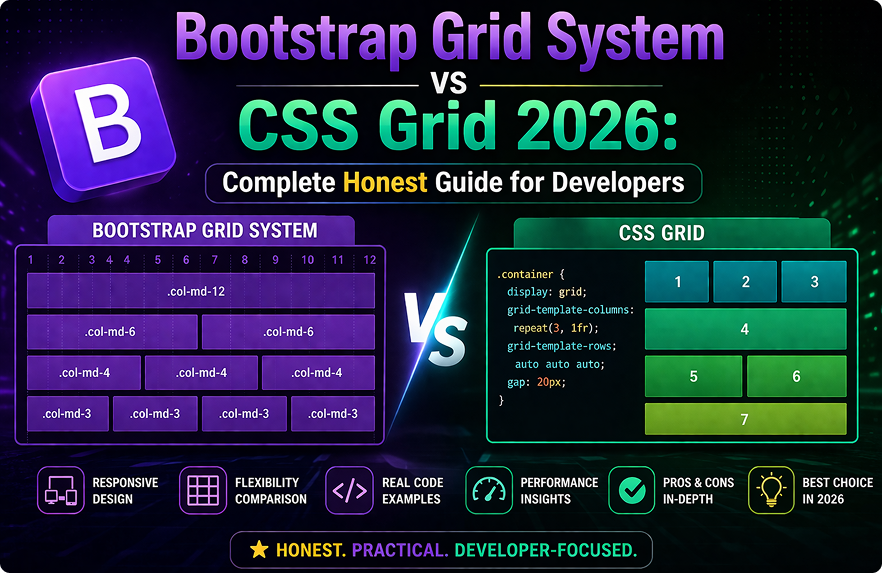
It’s also significantly easier to learn for complete beginners. The class names are semantic and descriptive. btn btn-primary clearly means “a button that is primary styled.” col-md-6 means “a column that takes half the width on medium screens.” You can read Bootstrap HTML and understand it immediately.
Bootstrap 5 also dropped jQuery as a dependency, making it lighter and more modern than earlier versions. The JavaScript components – dropdowns, modals, tooltips – now run on vanilla JS.
The Limitation You’ll Eventually Hit
The honest criticism of Bootstrap in the Bootstrap 5 vs Tailwind CSS debate is that Bootstrap sites tend to look similar to each other. The default styling is recognizable. Users who’ve spent time on the web can often identify a Bootstrap site immediately – not always a problem, but a real constraint if you need a distinctive visual identity.
Customizing Bootstrap deeply requires either overriding CSS with your own styles (which creates specificity battles) or configuring Bootstrap’s Sass variables before compilation. Neither is difficult, but both add friction that beginners don’t always anticipate.
How Tailwind CSS Works in Practice
The Core Idea
Tailwind CSS is a utility-first framework. There are no pre-built components. Instead, Tailwind provides hundreds of small, single-purpose utility classes – flex, items-center, px-4, text-gray-700, rounded-lg, shadow-md – that you compose directly in your HTML to build any design you want.
html
<!-- The same card built in Tailwind -->
<div class="bg-white rounded-lg shadow-sm p-6 border border-gray-100">
  <h5 class="text-lg font-semibold text-gray-900 mb-2">Article Title</h5>
  <p class="text-gray-600 mb-4">Some quick content goes here.</p>
  <a href="#" class="inline-block bg-blue-600 text-white px-4 py-2 rounded-md hover:bg-blue-700">
    Read More
  </a>
</div>
More classes, more control. Every visual decision is explicit and visible directly in the HTML.
Where Tailwind CSS Shines
In the Bootstrap 5 vs Tailwind CSS comparison, Tailwind wins clearly on design flexibility and uniqueness. Because you’re composing styles from scratch with utility classes, no two Tailwind projects look the same unless you deliberately copy each other.
Tailwind also produces smaller CSS files in production. Its built-in purge/tree-shaking system removes every utility class that isn’t actually used in your HTML. A production Tailwind CSS file is typically just a few kilobytes – dramatically smaller than a full Bootstrap bundle.
For developers working with component-based frameworks like React, Vue, or Svelte, Tailwind integrates extremely naturally. Your styles live right next to your component logic, and there’s no context switching between HTML and separate CSS files.
Tailwind’s design system is also exceptionally well-thought-out. The spacing scale, color palette, and typography system are internally consistent in a way that makes it easy to build visually coherent interfaces even without a professional designer.
The Learning Curve Is Real
The honest criticism in the Bootstrap 5 vs Tailwind CSS debate is that Tailwind has a steeper initial learning curve. When you first see Tailwind HTML, the long strings of utility classes look messy and overwhelming.
html
<button class="inline-flex items-center justify-center px-4 py-2 text-sm font-medium text-white bg-blue-600 border border-transparent rounded-md hover:bg-blue-700 focus:outline-none focus:ring-2 focus:ring-offset-2 focus:ring-blue-500">
  Submit
</button>
That’s a lot of classes for one button. You have to learn what each utility does before the system clicks. Most developers report a two-to-three week adjustment period before Tailwind starts feeling natural and fast.
Bootstrap 5 vs Tailwind CSS: Direct Comparison
Learning Curve
Bootstrap 5 is clearly easier for beginners. You can build something decent-looking within your first day. Tailwind requires learning the utility system first – expect a week or two before you’re truly productive.
Design Flexibility
Tailwind wins this category in the Bootstrap 5 vs Tailwind CSS comparison without contest. Bootstrap’s pre-built components are fast but visually constrained. Tailwind gives you complete design freedom — you’re limited only by CSS itself, not by a component library’s opinions.
Development Speed
For standard UI patterns – navbars, tables, forms, modals – Bootstrap is faster because the components already exist. For custom, unique designs, Tailwind is faster because you’re not fighting overrides. The right answer depends on what you’re building.
File Size in Production
Tailwind wins clearly. A purged Tailwind CSS file is often under 10KB. Bootstrap’s minified CSS is around 22KB minimum, and grows as you use more components. For performance-sensitive projects, this matters.
Community and Ecosystem
Both are excellent in the Bootstrap 5 vs Tailwind CSS comparison. Bootstrap has been around since 2011 and has enormous community resources, themes, and templates. Tailwind launched in 2017 and has grown extremely fast – its ecosystem of component libraries like shadcn/ui, Headless UI, and Flowbite has matured significantly.
Job Market Demand
Both appear regularly in job listings. Bootstrap knowledge is more commonly required in legacy codebases and corporate environments. Tailwind appears more frequently in modern startup stacks and React/Next.js projects. Learning either gives you real employable skills in 2026.
Who Should Learn Bootstrap 5
In the Bootstrap 5 vs Tailwind CSS decision, Bootstrap is the right choice if you’re a complete beginner to CSS frameworks who needs to build something functional quickly, if you’re working on admin panels, dashboards, or internal tools where visual uniqueness isn’t a priority, if you’re joining a team that already uses Bootstrap on an existing project, or if you’re building with plain HTML and JavaScript without a component framework.
Bootstrap also remains the safer choice for developers who find CSS challenging — the guardrails it provides help you build consistent interfaces without deep CSS knowledge.
Who Should Learn Tailwind CSS
In the Bootstrap 5 vs Tailwind CSS decision, Tailwind is the right choice if you’re working with React, Vue, Next.js, or any modern component-based framework, if you’re building projects that need a distinctive visual identity rather than a generic look, if you care about production CSS file size and performance, if you’re comfortable with CSS fundamentals and ready to work at the utility level, or if you’re joining a modern startup or product team where Tailwind has become the default.
Tailwind is also the better long-term investment for developers planning to build their own design systems or component libraries, since it gives you the vocabulary and structure to do that well.
For an in-depth reference on Tailwind’s utility system, the official Tailwind CSS documentation is exceptionally well-written and worth reading through completely. And for Bootstrap 5’s component library and grid system, the Bootstrap 5 official documentation covers every component with live examples.
If you’re also learning JavaScript fundamentals alongside this Bootstrap 5 vs Tailwind CSS decision, our JavaScript for beginners complete guide covers the DOM and event handling that makes both frameworks more useful. And for developers moving into React development where Tailwind is particularly popular, our React beginners guide 2026 explains how utility classes and component-based architecture work together naturally.
Can You Learn Both?
Absolutely – and many professional frontend developers know both well. The Bootstrap 5 vs Tailwind CSS question doesn’t have to be permanent. Bootstrap and Tailwind teach you different ways of thinking about CSS, and understanding both makes you a more versatile developer.
A practical sequence: learn Bootstrap first to understand component-based thinking and responsive grids quickly. Then learn Tailwind to understand utility-first design and build more custom interfaces. The concepts from each framework reinforce each other in ways that genuinely improve your overall CSS understanding.
Final Conclusion
The Bootstrap 5 vs Tailwind CSS comparison ultimately comes down to what you’re building and where you are in your learning journey. Neither framework is objectively better they’re optimized for different priorities and different workflows.
Bootstrap 5 is fast, beginner-friendly, and excellent for standard UI patterns and teams that need consistency without deep CSS expertise. Tailwind CSS is flexible, performant, and excellent for custom designs and developers comfortable working at the utility level.
If you’re just starting out, Bootstrap gets you building faster. If you’re working with modern JavaScript frameworks or need design flexibility, Tailwind is worth the learning investment. In 2026, both skills are genuinely marketable the Bootstrap 5 vs Tailwind CSS decision is less about which is “better” and more about which fits your current situation.
Pick one, build real projects with it, and you’ll develop the instinct for which tool belongs in which context naturally over time.