 Mukesh1@gmail.com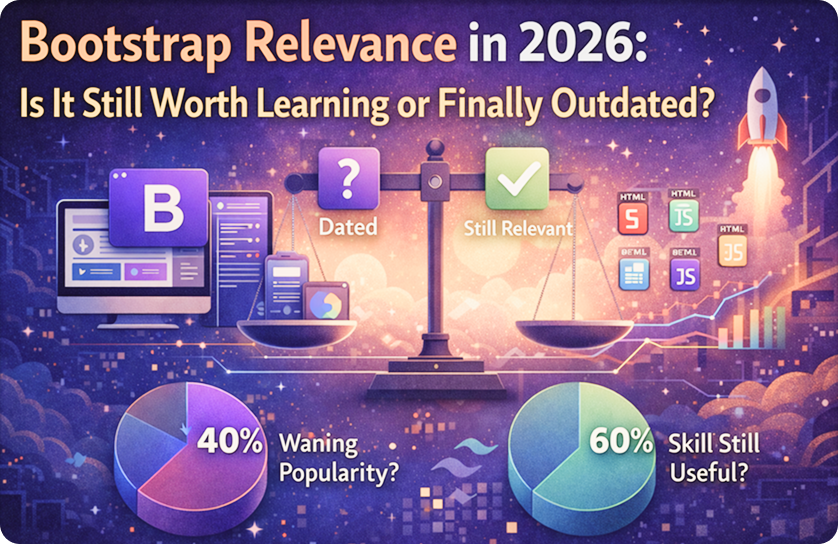
Every few months, the same debate resurfaces in developer communities. Someone posts “Is Bootstrap dead?” and the responses split immediately between developers who’ve moved entirely to Tailwind CSS and those who are still shipping production projects on Bootstrap without a second thought. The Bootstrap Relevance in 2026 question isn’t just philosophical — it has real implications for what you learn, what you build with, and how you advise teams on frontend tooling decisions.
This article approaches Bootstrap Relevance in 2026 honestly. No tribal loyalty to either side. Just a practical look at where Bootstrap actually stands — what it still does well, where it genuinely struggles against modern alternatives, who is still using it and why, and what the evidence suggests about its trajectory.
First, What Does “Relevant” Actually Mean Here?
Before getting into the comparison, it’s worth being precise about what relevance means in this context. A framework can be relevant without being the most popular choice. It can be the right tool for specific situations without being the right tool for all situations.
Bootstrap Relevance in 2026 really means: does Bootstrap still solve real problems for real developers in ways that justify learning it, choosing it for new projects, or maintaining existing codebases built on it?
That’s a more useful question than “is Bootstrap dead” — which is a false binary that generates heat without producing insight.
The Numbers Don’t Lie: Bootstrap Is Still Widely Used
Before making any claim about Bootstrap Relevance in 2026, it’s worth looking at actual usage data rather than relying on what’s trending on Twitter or which framework gets more GitHub stars this week.
The State of CSS surveys and npm download statistics consistently tell the same story. Bootstrap remains one of the most downloaded CSS frameworks globally. Millions of npm downloads per week. Hundreds of thousands of active repositories. A significant percentage of production websites — particularly in enterprise environments, government projects, educational institutions, and established businesses — are built on Bootstrap.
This isn’t nostalgia keeping those numbers up. Organizations don’t maintain production traffic on frameworks out of sentimentality. Bootstrap is being actively chosen for new projects in 2026 in specific contexts, and those contexts are worth understanding.
The State of CSS 2024 survey is worth reading for current developer sentiment data — it provides nuanced information about which frameworks developers are using, which they’re aware of, and how satisfaction has changed over time.
Where Bootstrap Still Wins Clearly
Large Teams With Mixed Skill Levels
Bootstrap’s component-first approach remains genuinely valuable in team environments where not every contributor is a frontend specialist. A backend developer who needs to build an admin interface, a full-stack developer who isn’t a CSS expert, a junior developer joining a project mid-stream — all of them can work productively with Bootstrap’s class-based system without deep frontend knowledge.
Tailwind requires a different kind of mental model. The utility-first approach rewards developers who think in design systems and are comfortable composing visual results from low-level classes. For experienced frontend developers, this is liberating. For mixed teams building internal tools, it creates friction that Bootstrap avoids.
Existing Codebases
A straightforward reality of Bootstrap Relevance in 2026 is that enormous amounts of production code use it. Bootstrap 4 and Bootstrap 5 projects are running in production at companies of every size. Those codebases need maintenance, new features, and eventual migration paths.
Developers who understand Bootstrap deeply are more valuable to employers maintaining these systems than developers who only know newer alternatives. This isn’t about Bootstrap being the best choice for new projects — it’s about recognizing that the industry’s existing code doesn’t disappear because new tools emerged.
Speed to Working UI for Non-Designers
Bootstrap’s prebuilt component library — navbars, modals, cards, forms, tables, dropdowns — means a developer without design skills can assemble a functional, reasonably professional-looking interface quickly. The components handle visual consistency, spacing logic, and responsive behavior by default.
With Tailwind, getting to the same place requires either a component library on top of Tailwind (like shadcn/ui or DaisyUI) or genuine design skill. Bootstrap compresses the path from blank file to working UI more than any utility framework does on its own.
Where Bootstrap Genuinely Struggles in 2026
Being honest about Bootstrap Relevance in 2026 requires acknowledging where Bootstrap has real weaknesses that aren’t just matters of preference.
CSS Bundle Size Without Custom Builds
Bootstrap’s full CSS is around 190KB unminified. In 2026, with performance budgets tightening and Core Web Vitals affecting search ranking, shipping 190KB of CSS on a project that uses thirty percent of Bootstrap’s components is a meaningful problem.
Tailwind with PurgeCSS generates only the CSS classes actually used in your project — often resulting in final stylesheets of 5–15KB for typical projects. The difference is significant for performance-sensitive applications.
Bootstrap’s response to this — custom Sass builds that include only needed components — works, but requires a build pipeline configuration that many teams don’t set up properly, leaving them shipping the full bundle anyway.
Utility Class Conflicts and Specificity
Bootstrap’s utility classes and component classes share the same specificity level, which creates situations where overriding Bootstrap’s defaults requires awkward CSS specificity management. Developers who’ve spent time debugging !important chains in Bootstrap projects know this pain firsthand.
Tailwind’s architecture makes this problem largely disappear because you’re composing from utilities rather than overriding component defaults.
Customization Still Requires Sass
Despite the CSS variable improvements in Bootstrap 5.3, deep theming still requires Sass compilation. You can change surface-level colors through CSS variable overrides, but anything touching Bootstrap’s internal calculation logic — spacing scales, breakpoint values, grid configuration — requires the Sass build pipeline.
In 2026, with CSS custom properties and native CSS tooling maturing rapidly, a framework that requires Sass for serious customization feels like unnecessary friction.
Tailwind vs Bootstrap: The Honest Comparison
This is where most Bootstrap Relevance in 2026 discussions either become tribal or avoid the specific comparisons that actually help developers make decisions.
Different Mental Models, Not Better vs Worse
Bootstrap thinks in components. You apply a class like btn btn-primary and get a complete, styled button with hover states, focus styles, and disabled states handled. Tailwind thinks in design properties. You apply bg-blue-600 text-white px-4 py-2 rounded hover:bg-blue-700 focus:ring-2 and compose the same button yourself.
Neither approach is objectively better. They reward different workflows and suit different teams. Experienced frontend developers who think in design systems and want full control often strongly prefer Tailwind. Developers who want to assemble working UIs quickly without thinking about design details often strongly prefer Bootstrap.
Learning Curve Direction
Bootstrap has a gentler entry curve but a steeper customization ceiling. You can build something functional in Bootstrap in an afternoon. Deeply customizing Bootstrap’s design system requires understanding Sass, CSS specificity, and Bootstrap’s internal architecture.
Tailwind has a steeper entry curve but a lower customization ceiling in practice — once you understand the utility system, customization is applying different utility values rather than fighting framework defaults.
When Tailwind Clearly Wins
For new projects where the development team is experienced with frontend, cares deeply about performance, wants precise design control, and is building a product with a distinctive visual identity — Tailwind is the stronger choice in 2026. The ecosystem around Tailwind (component libraries, design system tools, IDE integration) has matured considerably.
When Bootstrap Still Makes Sense
For projects with mixed-skill teams, internal tools where speed matters more than bundle size, organizations with existing Bootstrap infrastructure, and situations where ready-made components without design decisions are an asset — Bootstrap remains a practical choice, not a compromise.
The Rise of Utility CSS: Is Bootstrap’s Era Actually Over?
The framing of “Bootstrap’s era” assumes there was a singular era that has now ended. That’s not quite accurate. Bootstrap and utility CSS approaches coexisted for years, serve different needs, and will continue to do so.
What has changed is mindshare and momentum. Tailwind CSS has captured the attention of the developer community, the conference talks, the blog posts, and the new framework comparisons in a way that Bootstrap no longer does. Bootstrap isn’t generating excitement in 2026 — it’s generating stability.
That shift in mindshare is real and significant for Bootstrap Relevance in 2026 — not because stable frameworks are bad, but because a framework that isn’t attracting new contributors, new ecosystem tools, and community investment will eventually stagnate.
Bootstrap’s core team continues active maintenance. Bootstrap 5.3.x has received meaningful updates. The GitHub repository remains active. But the level of community energy around Bootstrap is genuinely lower than it was in 2018, and that matters for long-term trajectory.
What About Bootstrap 6?
No official Bootstrap 6 release date has been announced as of 2026. The expected direction — full CSS variable coverage, container query support, lighter bundle, better JavaScript framework integration — would address several of Bootstrap’s current weaknesses directly.
If Bootstrap 6 delivers on these fronts, it has a clear path to remaining competitive with utility frameworks for the use cases it serves. If Bootstrap 6 is delayed significantly or fails to modernize the framework’s architecture, Bootstrap Relevance in 2026 will gradually become a harder case to make as alternatives continue improving.
For developers following Bootstrap’s trajectory, the Bootstrap GitHub repository and the official blog are the most reliable sources for real development updates.
Practical Advice: What Should You Actually Do?
If You’re Starting Fresh in 2026
For a new project with an experienced frontend team — evaluate Tailwind seriously. The ecosystem, tooling, and community momentum are genuine advantages for greenfield projects.
For a new project with a mixed-skill team, tight timeline, or requirement for ready-made components — Bootstrap 5 remains a practical choice that will get you to working UI faster.
If You Already Know Bootstrap
Don’t abandon it. Bootstrap Relevance in 2026 is real enough that Bootstrap knowledge has ongoing value — particularly for employment in enterprise environments and agencies maintaining existing projects. Learn Tailwind alongside Bootstrap rather than treating it as a replacement.
If You’re Maintaining Bootstrap Projects
Stay on Bootstrap 5.3.x with proper Sass customization. Watch for Bootstrap 6 developments. Don’t migrate existing projects to Tailwind without a clear business reason — migrations consume time that could go into features.
Final Conclusion
Bootstrap Relevance in 2026 is real but contextual. Bootstrap is not the most exciting framework in the ecosystem, it’s not capturing developer mindshare the way it did in 2016, and it has genuine technical limitations that Tailwind handles better for certain use cases.
But it runs in production at scale, serves mixed-skill teams effectively, provides ready-made components that speed up UI development, and has an enormous existing codebase that needs maintaining. That combination keeps Bootstrap relevant in a practical sense even as utility CSS frameworks dominate new conversations.
The honest answer to “Bootstrap or Tailwind in 2026” is: learn both, understand what each one does well, and choose based on your specific project context rather than what’s trending. A developer who can work effectively in both is more valuable and more versatile than one who treats the choice as an identity.