 Mukesh1@gmail.com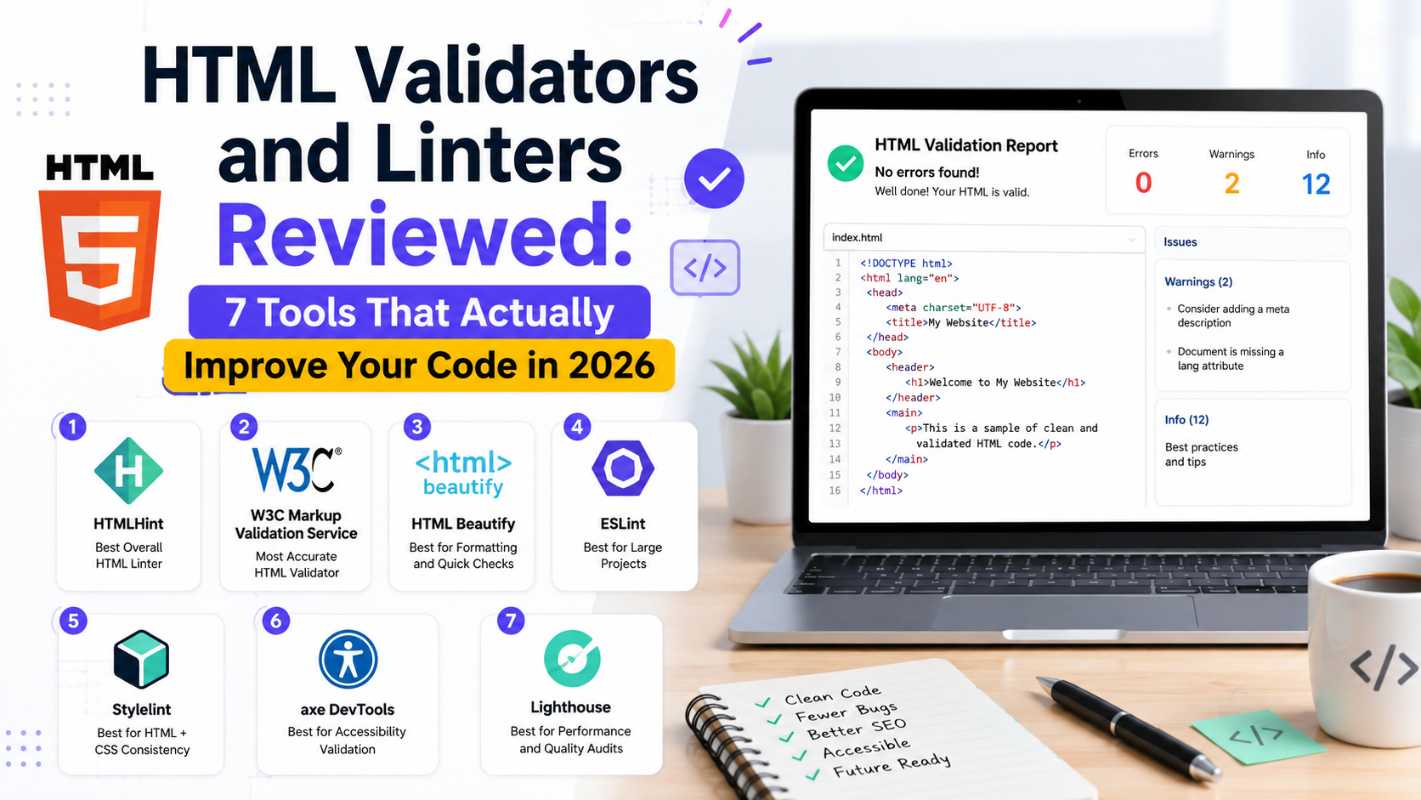
If you’ve ever stared at a webpage that looks broken and had no idea why, there’s a good chance your HTML had errors sitting quietly in the background. That’s exactly where HTML validators and linters come in. These tools catch mistakes you might miss, help you write cleaner markup, and save you from debugging nightmares later. I’ve spent time actually using several of them, and this review is based on real experience — not just feature lists.
What Are HTML Validators and Linters, Really?
People often use these two terms like they mean the same thing, but they’re slightly different in practice.
A validator checks whether your HTML follows official web standards — basically, does your code play by the rules set by the W3C? A linter, on the other hand, goes a step further. It checks for style issues, potential accessibility problems, bad practices, or even deprecated tags — things a validator might not flag at all.
Think of a validator as a grammar checker and a linter as an editor who tells you your sentence is technically correct, but still awkward.
For developers working on real projects, you usually want both. Together, HTML validators and linters give you a more complete picture of your code quality.
Why Bother? The Real Cost of Skipping Validation
I used to skip validation when I was starting out. Big mistake.
Unchecked HTML can cause layout issues across different browsers, break accessibility for screen reader users, and even hurt your SEO. Search engines read your markup too. Messy, invalid code can confuse crawlers and affect how your pages rank.
Beyond that, poorly structured HTML is just harder to maintain. When a project grows, bad habits compound. Something that looks fine on Chrome today might fall apart on Safari or an older Android browser tomorrow.
Running your code through HTML validators and linters regularly isn’t extra work — it’s how professionals stay sane on bigger projects.
1. W3C Markup Validation Service — The Original Standard
URL: validator.w3.org
This is the one most developers hear about first, and for good reason. The W3C validator has been around for a long time, and it’s still maintained. You can paste HTML directly, provide a URL, or upload a file.
The results are clear: it flags errors with line numbers and explains what went wrong. For beginners, this is genuinely useful because the explanations are fairly readable.
What it doesn’t do is flag style or accessibility issues. It’s a pure standards checker. So if you use a valid but outdated tag that’s bad practice, it probably won’t say a word.
Still, for anyone learning HTML, this should be the first stop when something looks off. It’s free, reliable, and backed by the actual organization that defines web standards.
2. HTMLHint — A Proper Linter for Your Workflow
URL: htmlhint.com
HTMLHint is where things get more practical for working developers. It’s a static analysis tool — meaning it doesn’t run your page, it reads your code and finds problems before you even open a browser.
You can install it via npm and run it from the command line, which makes it easy to plug into build tools like Webpack or scripts in your project. It checks for things like:
- Missing alt attributes on images
- Duplicate IDs
- Inline styles that should be moved to CSS
- Tags that aren’t properly closed
The rule configuration is flexible, which means you can enable or disable specific checks based on your team’s preferences. Out of the tools I’ve used, HTMLHint fits most naturally into a development workflow without feeling like a chore.
If you’re new to linting in general, this is a solid starting point. It’s among the most beginner-friendly HTML validators and linters that actually integrate into real projects.
3. Nu HTML Checker — W3C’s More Modern Tool
The Nu HTML Checker is essentially the upgraded engine behind the W3C validator, but available as its own tool. You can access it at validator.nu or run it locally as a Java-based tool.
What’s useful here is that it validates against modern HTML5 standards specifically. The older W3C validator sometimes lags behind with newer elements. Nu is faster at recognizing HTML5 semantics properly.
The output is sometimes more verbose than the W3C service, but the detail is actually helpful when you’re trying to understand why something fails, not just that it does.
For production projects targeting modern browsers, this one earns its spot in the HTML validators and linters toolkit.
4. Lighthouse — Google’s Built-In Audit Tool
Lighthouse isn’t a dedicated HTML linter, but it’s worth including here because it does check HTML quality as part of a broader audit. It’s built right into Chrome DevTools under the “Lighthouse” tab.
When you run an audit, it checks accessibility, best practices, performance, and SEO — all of which relate back to your HTML structure. It’ll flag things like:
- Missing form labels
- Improper heading hierarchy (jumping from H1 to H4, for example)
- Images without descriptive text
What I like about Lighthouse is that it shows you impact. It doesn’t just say “this is wrong” — it tells you how fixing it might improve your accessibility score or SEO ranking. That context is useful when you’re deciding what to fix first.
It’s not a replacement for dedicated HTML validators and linters, but it’s a great companion tool, especially for web developers who care about real-world performance.
5. Prettier with HTML Support — Format, Don’t Just Fix
Prettier is primarily a code formatter, not a validator. But formatting and validation are closer than most beginners realize. Inconsistently formatted HTML is harder to read, easier to break, and more likely to hide actual bugs.
With Prettier configured for HTML, it will reformat your markup into a consistent structure every time you save. Attributes get aligned. Nesting is corrected. Messy multi-line tags get cleaned up.
Used alongside a proper linter, Prettier makes a real difference in day-to-day code quality. It doesn’t catch logical errors, but it removes the visual noise that makes errors harder to spot.
6. Webhint — Broader Web Quality Checks
URL: webhint.io
Webhint takes a different approach from most HTML validators and linters. It audits an entire website rather than just a single file, and it checks for a wide range of issues including compatibility problems, security headers, accessibility, and performance.
You can run it through their browser extension or via the CLI. The browser extension is especially convenient for quick checks.
The results are organized into categories, which makes it easier to prioritize fixes. It’s more opinionated than some tools, but the hints it gives are grounded in real web development best practices, not just theoretical correctness.
For developers who want one tool to surface a wide range of issues across a live page, Webhint earns its place.
7. VS Code Extensions — Validation Where You Type
If you use Visual Studio Code (which most developers do now), there are several extensions that bring HTML validators and linters right into your editor. The most useful ones include:
- HTMLHint extension — runs HTMLHint rules as you type
- W3C Web Validator — validates HTML against the W3C standard without leaving VS Code
- Markuplint — a newer, more modern linter with good HTML5 and accessibility support
Having these in your editor means you catch issues immediately, not after you’ve written 200 lines. That immediate feedback loop is genuinely valuable for building better habits.
For further reading on clean code practices, the MDN Web Docs on HTML is an excellent ongoing reference.
H3: Which Tool Should a Beginner Start With?
If you’re new to web development, start with the W3C validator for basic error checking, then add HTMLHint once you’re comfortable with the command line. These two together — one validator, one linter — will handle most common problems without overwhelming you.
As your projects grow, bring in Lighthouse for real-world impact analysis and consider a VS Code extension so feedback becomes part of your natural editing flow.
Common Mistakes These Tools Will Catch
Across my own projects and reviewing others’ code, the same issues come up repeatedly:
- Unclosed tags that only break on certain browsers
- IDs used more than once on the same page
- Form inputs without labels (a big accessibility issue)
- Images without alt text
- Skipped heading levels that hurt both readability and SEO
The honest truth is, even experienced developers make these mistakes when moving fast. That’s not a failing — it’s just how coding works. What separates good developers isn’t not making mistakes, it’s having systems to catch them quickly.
HTML validators and linters are exactly that kind of system.
Final Conclusion
Writing HTML is one thing. Writing HTML that’s clean, accessible, and built to last is another. The tools reviewed here — from the long-standing W3C validator to modern editor extensions — all serve a purpose in getting there.
You don’t need to use all of them. Pick one validator and one linter that fits your workflow, and use them consistently. Over time, you’ll notice patterns in your mistakes, fix them at the source, and write better code from the start.
The best thing about HTML validators and linters is that they’re mostly free and available right now. There’s no good reason to write code without them.