 Mukesh1@gmail.com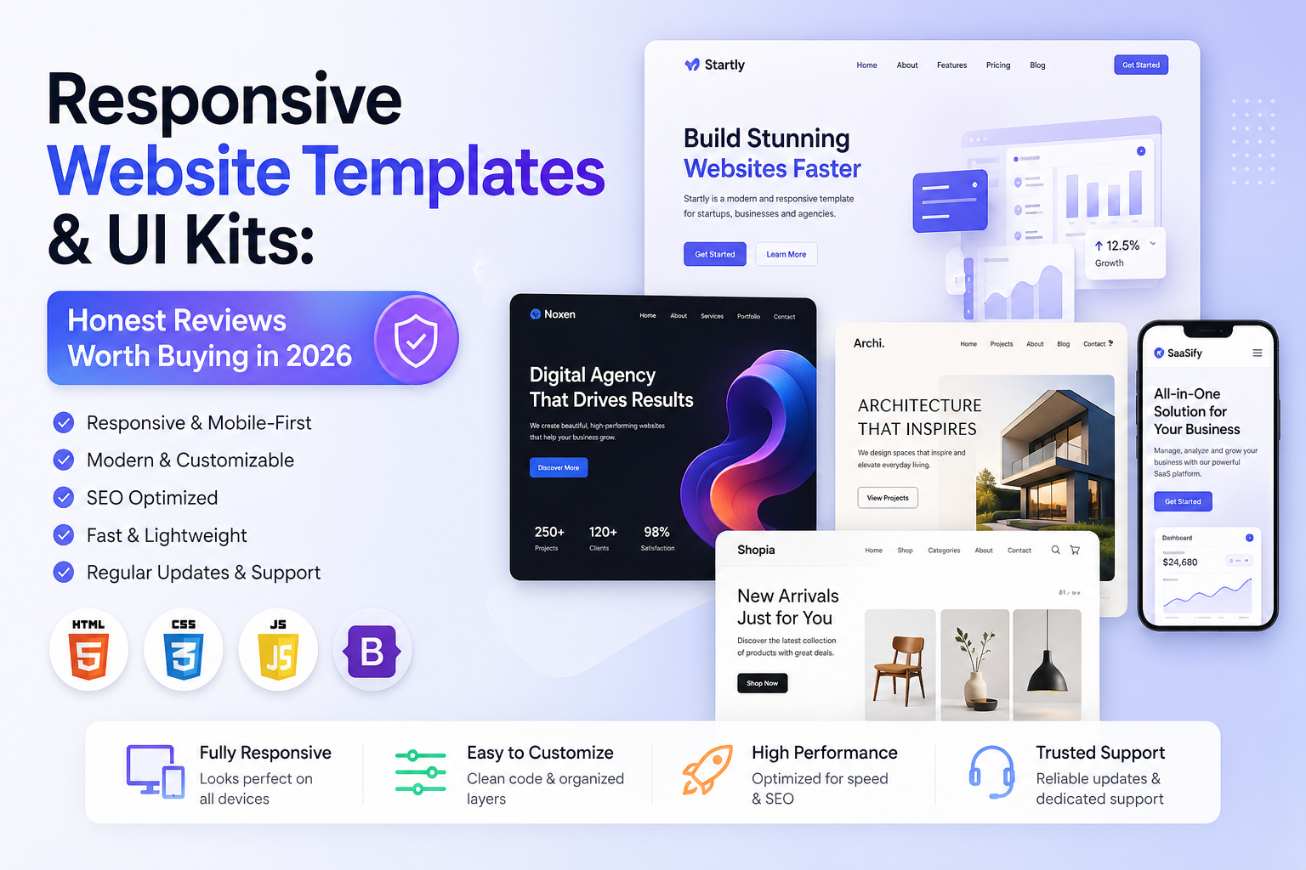
Introduction
Every developer or designer has been there. You have a new project, a tight deadline, and building everything from scratch feels like climbing a mountain you did not sign up for. That is where responsive website templates come in — and in 2026, the market for them is bigger, and honestly, more confusing than ever.
There are thousands of options. Free ones, premium ones, React-based, HTML-only, full UI kits, minimal starters. Knowing which ones are actually worth your time — and your money — takes real research.
This guide is that research. We are going to look at what makes a responsive website template genuinely good, review some of the top categories and platforms, break down what UI kits actually offer, and give you an honest answer on whether buying premium is worth it in 2026.
No affiliate fluff. Just practical, experience-based perspective.
What Makes a Responsive Website Template Actually Good?
Before jumping into specific products, it helps to know what separates a quality responsive website template from one that just looks good in a preview screenshot.
Here are the things that matter in real use:
True responsiveness across breakpoints. Not just “it looks okay on mobile” — but genuinely tested at 320px, 768px, 1024px, and 1440px. A lot of templates cut corners here. The hero section might be fine, but the footer collapses or the navigation breaks on mid-size tablets.
Clean, organized code. If you purchase a responsive website template and open the files to find six nested div layers with inline styles scattered throughout, you are going to spend hours cleaning it up. Good templates use semantic HTML, consistent CSS class naming (BEM or something similar), and minimal third-party bloat.
Active maintenance. Especially for frameworks like React, Next.js, or Tailwind — a template built on outdated library versions can cause real headaches. In 2026, you want something that was updated within the last six months at minimum.
Accessibility basics. Alt attributes, keyboard navigability, proper heading hierarchy. These are not optional for professional projects anymore, and a good responsive website template will have them handled.
Free vs Premium Responsive Website Templates – The Real Difference
This is a question that comes up constantly, especially for beginners. Is it worth paying $30, $60, or even $150 for a template when so many free ones exist?
Honestly — it depends on what you are building.
When free templates work fine:
- Personal portfolios or hobby projects
- Prototypes or client presentations
- Learning exercises where you plan to heavily customize everything anyway
When premium responsive website templates earn their price:
- Client work where you bill for your time
- Projects that need a complete design system, not just a starting layout
- When the template includes licensing for commercial use, documentation, and support
The real hidden cost of a poor free template is your time. If you spend 8 hours hacking around broken layouts or fighting undocumented JavaScript dependencies, a $49 premium template that just works would have paid for itself twice over.
That said, some free responsive website templates are genuinely excellent. The open-source community has matured considerably.
Top Platforms for Responsive Website Templates in 2026
Rather than reviewing individual products (which go in and out of maintenance constantly), let us look at where to find quality templates and what each platform offers.
ThemeForest (Envato Market)
ThemeForest remains one of the largest marketplaces for responsive website templates in 2026. The sheer volume is both its strength and weakness.
What is good: You can find templates for almost any niche — agency sites, SaaS landing pages, portfolios, e-commerce. Many come with extensive documentation and demo content. User reviews are generally reliable.
What to watch out for: Some older bestsellers have not been updated in years. Always check the “Last Updated” date before buying. Also, the sheer number of options can make decision-making overwhelming.
Price range: $14–$79 for most HTML and Bootstrap-based responsive website templates. React and Next.js kits run higher.
UI8 – Design-Forward UI Kits
UI8 is more focused on UI kits and Figma/Sketch resources than pure code templates. If you are a designer who then hands off to a developer, or if you work in both disciplines, this platform is worth knowing.
The responsive website templates and component libraries here tend to be visually polished — more thoughtfully designed than many marketplace templates. They are built for designers who care about grid systems, spacing tokens, and type scales.
What is good: High aesthetic quality. Many kits include both design files and coded components. Strong focus on design systems rather than just page layouts.
What to watch out for: Priced higher than HTML template marketplaces. Some kits are design-file-only with no code equivalent, which adds implementation work.
Tailwind UI and Headless UI
For developers working in the React and Vue ecosystem, Tailwind UI is one of the most practical sources of responsive website templates and component libraries in 2026.
It is not a marketplace — it is a product from the Tailwind CSS team. One purchase gives you access to hundreds of pre-built components and full page templates, all built with Tailwind CSS and available in React, Vue, and plain HTML.
What is genuinely useful here: The code quality is exceptional. These are not visually flashy templates — they are clean, well-structured, and completely customizable because you own every line of Tailwind class. For developers building production apps, this is one of the most practical purchases available.
What to consider: It requires Tailwind CSS knowledge. If you are new to Tailwind, there is a learning curve before the templates feel natural to work with.
GitHub and Open Source Starters
Do not underestimate what is available for free on GitHub. In 2026, frameworks like Astro, Next.js, SvelteKit, and Nuxt all have rich ecosystems of open-source starter templates and themes.
Many of these are maintained by active communities and kept up to date with framework changes. For a developer who is comfortable with these tools, a well-chosen open-source responsive website template can be genuinely superior to a paid option.
The trade-off is documentation and support. You are typically on your own if something breaks or you need help with customization.
What Are UI Kits and How Are They Different?
A lot of people use “template” and “UI kit” interchangeably, but they are meaningfully different things.
A responsive website template is typically a finished or near-finished page layout. You take it, swap in your content, adjust the branding, and you have a website.
A UI kit is more like a box of Lego pieces. It gives you pre-built buttons, form elements, cards, navigation patterns, modals, and so on — but not assembled into a specific layout. You pick the pieces you need and assemble them yourself.
When UI kits make more sense:
- You are building a custom product or app with a unique structure
- You need design consistency across dozens of different screens or pages
- You are working in a team where designers and developers share a component language
When a template makes more sense:
- You need something up quickly
- The project fits a common website type (portfolio, agency, blog, landing page)
- You want design decisions already made so you can focus on content
In practice, many premium responsive website templates in 2026 include both — a set of pre-built pages and a component library you can use to extend or create new sections. That combination is often the best value.
Red Flags to Avoid When Buying Responsive Website Templates
After working with dozens of templates over the years, these are the warning signs worth watching for before you buy.
No live demo or preview. If a seller does not provide a working demo of a responsive website template, assume the worst. Screenshots are easy to fake or cherry-pick.
Unusual dependency lists. A simple landing page template that requires jQuery, three different slider libraries, a lightbox plugin, and a custom icon font has serious bloat. Modern responsive website templates should be leaner.
Poorly structured demo HTML. Before buying, look at the preview source if you can. Tables for layout in 2026 is an automatic disqualifier. Deeply nested divs without semantic structure suggests the developer cut corners throughout.
Missing documentation. Good templates come with setup instructions. If the download is just a zip of files with no README, no changelog, no guidance at all — that is a signal that support will also be nonexistent.
Copyright ambiguity. Always read the license. Some templates sold as “regular licenses” restrict commercial use or require attribution. For client work, you typically need an extended or commercial license.
Are Premium Responsive Website Templates Worth It in 2026?
Let us be direct about this.
Yes — if you pick carefully. A well-chosen premium responsive website template from an actively maintained source with good documentation can save 15–30 hours of design and development time on a typical project. At any reasonable freelance rate, that math makes even a $79 template an obvious value.
No — if you do not vet them properly. Buying a premium template that is outdated, poorly coded, or built on a deprecated framework wastes both money and more time than starting fresh. The price tag does not guarantee quality.
The smartest approach in 2026 is this: spend 20–30 minutes evaluating any template before purchasing. Check the update history, read actual user reviews (not star counts — read the text), look at the demo on a real mobile device, and confirm the license covers your use case.
A responsive website template is a tool, not a magic solution. The right tool for the right job saves enormous time. The wrong one costs more than it saves.
Responsive Website Templates for Specific Use Cases
Different projects call for different starting points. Here is a practical breakdown.
For SaaS or tech products: Look for templates built with Tailwind CSS or CSS custom properties. You need strong typography, clear feature sections, and pricing table components. Platforms like Tailwind UI or Cruip specialize here.
For portfolios and freelancers: Minimalist, fast-loading responsive website templates with clean project grid layouts work best. Many excellent free options exist here — Astro’s theme ecosystem has some genuinely beautiful portfolio starters.
For agencies and studios: More elaborate multi-page templates with animation support are common needs. ThemeForest has a deep catalog here, though careful vetting matters more than usual.
For blogs and content sites: Ghost themes, WordPress themes (Kadence, GeneratePress), or Jekyll/Hugo starters are often better specialized options than generic responsive website templates for pure content-focused sites.
A Note on Accessibility in 2026
This deserves its own mention. Web accessibility standards (WCAG 2.2) are increasingly being referenced in legal contexts in several countries, and in 2026, accessibility is not just good practice — it is risk management for commercial sites.
When evaluating any responsive website template, run the demo through a basic accessibility check. Tools like the WAVE Web Accessibility Evaluator are free and take about two minutes to use. Pay attention to color contrast issues, missing form labels, and images without alt text.
Templates that score badly on basic accessibility checks will cost you remediation time downstream — or worse, cause real problems for users with disabilities.
Resources to Find Quality Templates and UI Kits
Beyond the platforms already mentioned, a few resources consistently surface quality work:
The Awwwards Site of the Day archive is useful not for downloading templates but for understanding what genuinely excellent responsive design looks like in practice. It calibrates your taste.
For React-specific component libraries and starters, shadcn/ui has become a widely respected open-source choice in 2026 — highly customizable, well-documented, and built on Radix UI primitives.
Final Conclusion
Responsive website templates and UI kits are genuinely useful tools when chosen with care. In 2026, the market is mature enough that both free and premium options of real quality exist — but so do plenty of overpriced, outdated, or poorly coded options that will cost you more than they save.
The key is evaluation before purchase. Check maintenance history, test on real devices, read the license, and make sure the code quality holds up under inspection. A responsive website template that ticks those boxes is absolutely worth buying for most professional projects.
If you are a beginner, start with a reputable free option to learn the workflow. As your projects grow in scope and your client rate increases, premium templates become easier to justify and faster to recoup.
The best responsive website template is not the most expensive or the most downloaded — it is the one that fits your project, saves you real time, and does not create new problems in the process.