 Mukesh1@gmail.com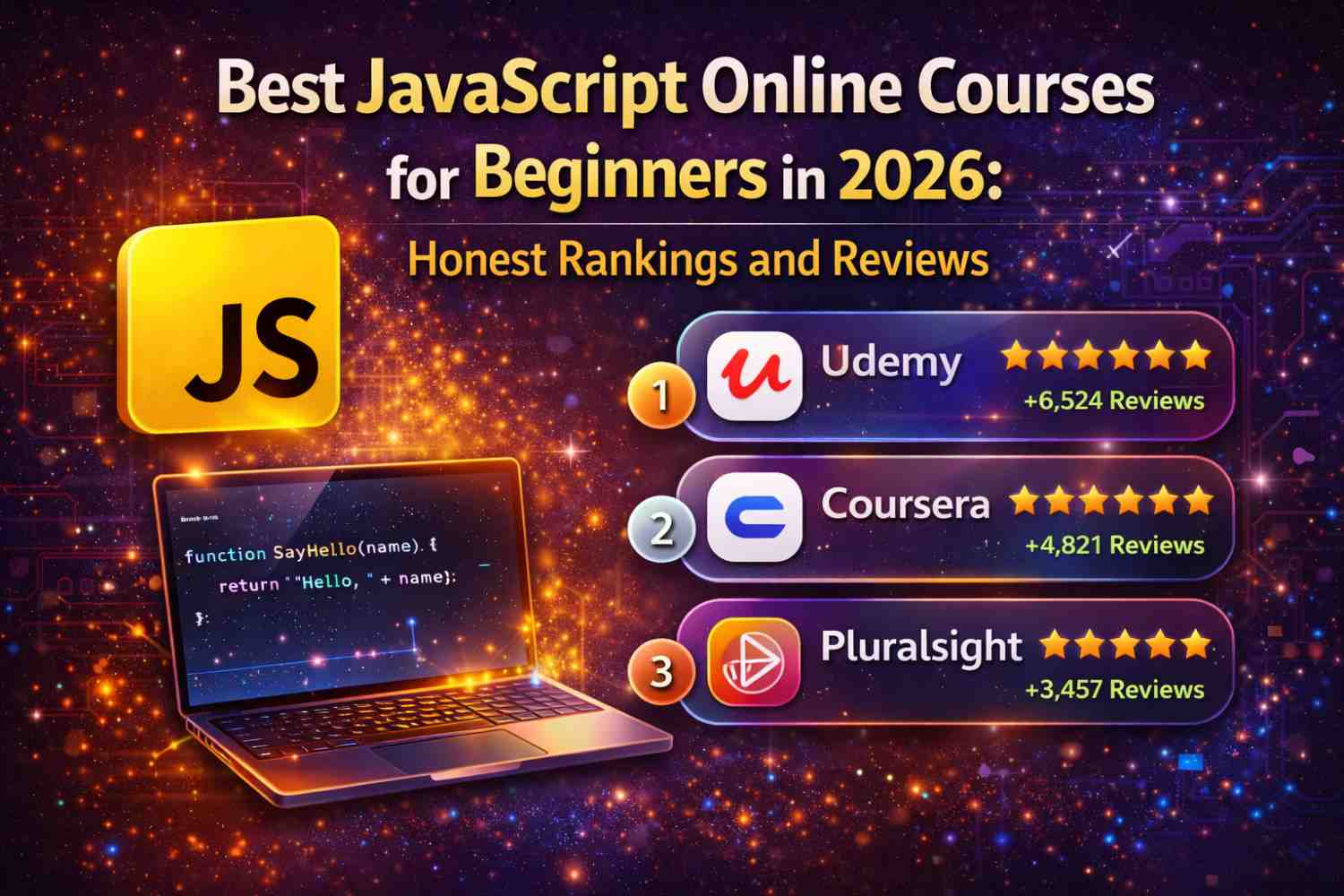
Introduction
Learning JavaScript for the first time can feel overwhelming. There are hundreds of courses out there, each one promising to turn you into a developer in 30 days, and it’s genuinely hard to know which ones are worth your time. That’s exactly why this guide exists. If you’re searching for JavaScript online courses for beginners, you don’t just need a list — you need honest context, real comparisons, and practical guidance on what to expect from each option.
In 2026, the landscape has matured quite a bit. Some platforms have improved significantly. Others have been coasting on old content. A few newer options have appeared that are actually excellent for complete beginners. This review covers all of that, based on what’s actually inside these courses — not just what their sales pages say.
What to Look for in JavaScript Online Courses for Beginners
Before jumping into rankings, it’s worth knowing what separates a genuinely good beginner course from one that just looks polished.
Clear explanations over speed. A lot of courses try to cover as much as possible as fast as possible. For beginners, that’s counterproductive. You need concepts explained clearly, with time to absorb them, not a race to the finish line.
Hands-on practice, not just watching. Watching someone code and actually coding are completely different experiences. The best JavaScript online courses for beginners include real exercises, small projects, and challenges that force you to apply what you’ve learned.
Honest scope. JavaScript is a large language. A beginner course shouldn’t try to cover everything — it should build a solid foundation and tell you clearly where to go next.
Active community or support. When you get stuck (and you will), having somewhere to ask questions matters a lot. Courses with active forums, Discord communities, or Q&A sections are meaningfully better than solo learning experiences.
The Best JavaScript Online Courses for Beginners in 2026 – Ranked
Here are the top options reviewed honestly, in order of overall value for complete beginners.
1. The Odin Project – Free and Genuinely Excellent
If budget is a concern, The Odin Project should be your first stop when looking for JavaScript online courses for beginners. It’s completely free, open-source, and has been refined by a community of developers over many years.
The curriculum is project-based from the start. You don’t just read about loops and arrays — you build things with them. The JavaScript Foundations section covers variables, functions, conditionals, and the DOM in a logical sequence. After that, you move into more practical territory with form validation, calculator apps, and eventually browser-based games.
What makes it different from most platforms is the emphasis on actually reading documentation and figuring things out independently — which is exactly what real developers do. It can feel harder than a polished video course, but that difficulty is part of the learning.
Best for: Self-motivated beginners who don’t mind doing some independent research and prefer reading and building over watching.
Cost: Free
Approximate time to complete foundations: 3–5 months at a reasonable pace
2. freeCodeCamp JavaScript Algorithms and Data Structures – Free, Structured, and Certifiable
freeCodeCamp is one of the most popular JavaScript online courses for beginners in the world, and it holds that position for good reason. The curriculum is entirely browser-based — you write code in a built-in editor and get immediate feedback — which removes the friction of setting up a development environment before you’ve even learned the basics.
The JavaScript Algorithms and Data Structures certification covers everything from basic syntax through ES6 features, regular expressions, debugging, and basic algorithms. Each section has dozens of small exercises that build on each other.
The certification at the end, while not employer-recognized on its own, is a useful milestone and gives you something to show for your progress. The project requirements for the certification — building things like a palindrome checker and a Roman numeral converter — are actually good practice.
One honest limitation: the platform is text-heavy. If you learn better from video explanations, you might find freeCodeCamp’s written lessons a bit dry. It pairs well with YouTube tutorials for the concepts you find harder to grasp through reading alone.
Best for: Beginners who want structure, free access, and a clear path with measurable milestones.
Cost: Free
Approximate time: 200–300 hours for the full certification
3. JavaScript: Understanding the Weird Parts (Udemy) – Best for Deep Understanding
Anthony Alicea’s “JavaScript: Understanding the Weird Parts” is one of the most respected JavaScript online courses for beginners who want to actually understand the language rather than just memorize syntax. It’s available on Udemy, which runs sales frequently — expect to pay between $15–$20 rather than the listed price.
The course goes deep on concepts that confuse most beginners: execution context, closures, prototypal inheritance, the this keyword, and how the JavaScript engine actually runs your code. These aren’t beginner-friendly topics by reputation, but Alicea explains them with diagrams and slow, deliberate walkthroughs that genuinely make them click.
This isn’t a course that holds your hand through building projects. It’s more conceptual. But if you pair it with a project-based resource like The Odin Project or freeCodeCamp, the combination is excellent — you get practical skills from one and genuine understanding from the other.
Best for: Beginners who feel frustrated by not understanding why JavaScript works the way it does, not just how to use it.
Cost: $15–$20 on sale (check Udemy regularly)
Approximate time: 17–20 hours of video
4. Scrimba – JavaScript Online Courses for Beginners Who Learn by Doing
Scrimba has a unique format that’s worth knowing about. Their courses use an interactive video player where you can pause the lesson and edit the code right inside the video. It sounds gimmicky, but in practice it’s one of the most effective ways to learn — you’re never just passively watching.
Their free “Learn JavaScript” course is well-structured and beginner-appropriate. The instructor explains concepts clearly, and the interactive format means you’re constantly practicing rather than deferring practice to a later exercise.
Scrimba also has an active Discord community where beginners ask questions and get answers from other learners and mentors. For people who feel isolated learning alone, that community aspect makes a real difference.
The platform’s paid Pro tier unlocks more advanced content and projects, but the free JavaScript course is enough to get a solid beginner-level foundation.
Best for: Visual learners and people who struggle to stay engaged with traditional video courses.
Cost: Free (core course); Pro plan available
Approximate time: 6–11 hours for the core JavaScript course
5. Codecademy Learn JavaScript – Smoothest Onboarding Experience
Codecademy’s “Learn JavaScript” course is probably the gentlest entry point among all the JavaScript online courses for beginners on this list. Everything happens in the browser, the interface is clean and encouraging, and the lessons start from an absolutely foundational level — assuming you know nothing.
The course walks you through variables, data types, conditionals, functions, scope, arrays, loops, objects, and iterators. It’s thorough for a beginner course, and the in-browser coding environment means you’re writing actual JavaScript from day one.
The honest criticism is that Codecademy’s exercises can feel a bit too hand-holdy. They guide you so closely that you can complete them without fully internalizing what you’re doing. It’s worth using Codecademy as a first exposure, then immediately building something small on your own to test whether you actually understand the concepts.
Codecademy Pro (paid) unlocks quizzes, projects, and a certificate. The free tier covers enough to get started, but the paid version is more complete.
Best for: Absolute beginners who want the smoothest possible start without any setup friction.
Cost: Free (limited); Pro from ~$17/month
Approximate time: 10–15 hours for the core course
6. CS50’s Web Programming with Python and JavaScript (Harvard/edX) – Best Academic Option
Harvard’s CS50 courses are known for their quality, and the Web Programming course that includes JavaScript is no exception. It’s available free on edX and covers JavaScript in the context of real web development — including DOM manipulation, event handling, fetch API calls, and working with frameworks like React at an introductory level.
This is heavier than most JavaScript online courses for beginners in terms of pace and expectations. It assumes some familiarity with programming concepts (the introductory CS50x course is a good prerequisite). But if you’ve already done some coding before, this course will give you a much more complete picture of where JavaScript fits in modern web development.
Assignments are challenging and genuinely useful. Building projects that interact with a backend, handle user authentication, and communicate with APIs is a meaningful step up from toy exercises.
Best for: Beginners who have some prior programming experience and want a rigorous, academic-quality introduction.
Cost: Free to audit; certificate available for a fee
Approximate time: 12 weeks at a moderate pace
How to Choose the Right JavaScript Online Course for Beginners
With six solid options reviewed above, the question becomes: which one is right for you specifically?
Here’s a practical way to think about it.
If you have zero coding experience: Start with Codecademy or Scrimba. Both ease you in gently and get you writing code immediately with clear feedback.
If you’re self-motivated and want the best long-term outcome for free: The Odin Project is the strongest full curriculum. Pair it with freeCodeCamp for extra practice on specific topics.
If you want to understand JavaScript deeply, not just use it: Add “JavaScript: Understanding the Weird Parts” to whatever practical course you’re following.
If you’ve coded before in another language: CS50 Web Programming will challenge you in a productive way and give you professional context faster.
The most common mistake beginners make is hopping between courses. Pick one, commit to finishing it, and build something small — even a simple to-do list — before moving to the next one. Completion and practice matter more than finding the perfect course.
What JavaScript Beginners Should Focus on After Finishing a Course
Completing one of these JavaScript online courses for beginners is a milestone, not a finish line. Here’s what actually helps you grow after your first course ends.
Build things you care about. Even small projects teach you things no course does — what to do when something doesn’t work, how to read error messages, how to look up documentation. Pick something simple that interests you and build it.
Learn to read the MDN Web Docs. The Mozilla Developer Network is the most reliable reference for JavaScript. Getting comfortable reading official documentation is a skill that separates developers who keep growing from those who get stuck.
Don’t rush into frameworks. React, Vue, and Angular are important eventually, but they make much more sense once you’re comfortable with plain JavaScript. Spend real time with the fundamentals before adding a framework on top.
Write code every day, even a little. Consistency beats intensity. Thirty minutes of daily coding practice produces better results than weekend cramming sessions.
Final Conclusion
In 2026, there has never been more access to quality JavaScript online courses for beginners. Free options like The Odin Project and freeCodeCamp are genuinely excellent. Platforms like Scrimba and Codecademy make the first steps approachable. Deeper resources like Udemy’s weird parts course and Harvard’s CS50 add context and understanding that surface-level courses skip.
The honest truth is that no single course will make you a JavaScript developer. What does it is consistent practice, building real things, and staying curious about how the language actually works. These courses give you the foundation — what you build on top of it is up to you.
Pick one course from this list that matches your current level and learning style. Start today, not after researching more options. The best JavaScript online course for beginners is always the one you actually finish.