 Mukesh1@gmail.com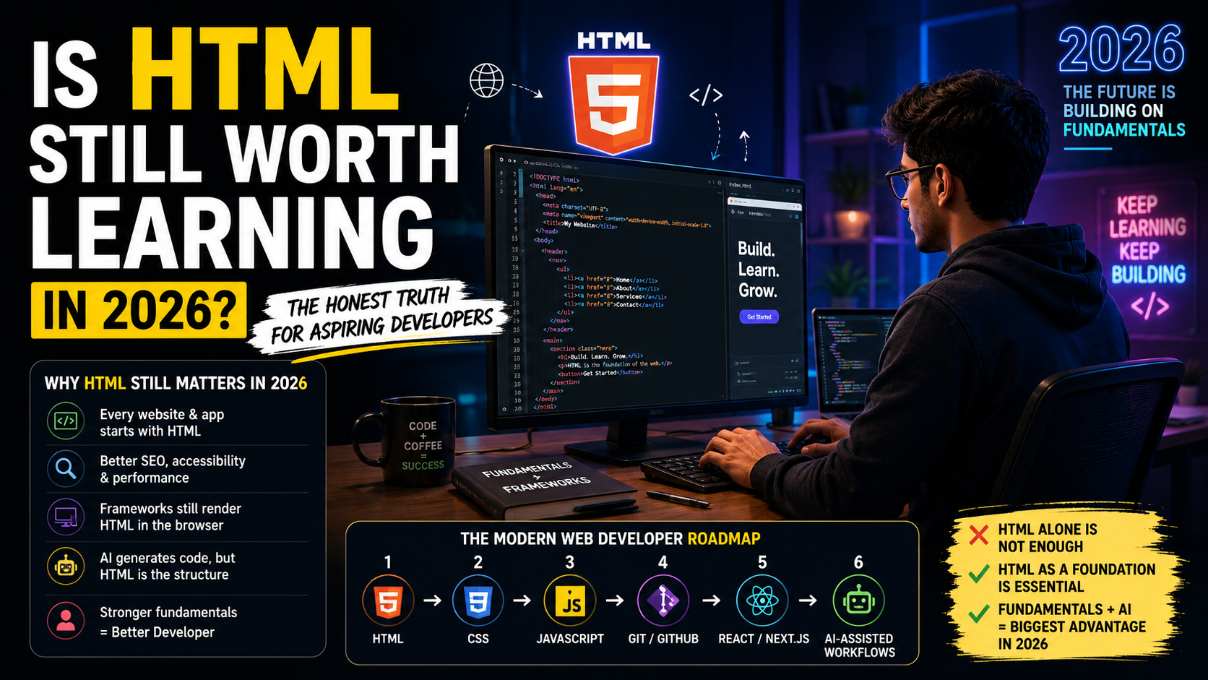
Every few months, someone posts a question online that gets hundreds of responses: Is HTML still worth learning, or has it been replaced by frameworks and AI tools?
The answers vary wildly. Some developers say HTML is dead. Others say it’s more important than ever. Beginners reading those threads usually end up more confused than when they started.
So here’s a straight answer, based on how web development actually works in 2026 — not how people theorize about it online. HTML still worth learning isn’t just a debatable opinion. It’s a practical reality that shows up every single day in real development work.
The Question Behind the Question
When someone asks “is HTML still worth learning,” they’re usually asking something slightly different underneath. They’re asking: will this skill get me somewhere? Will it still matter in two years? Or am I spending time on something that’s about to become irrelevant?
Those are fair concerns. The tech industry does move fast. Tools do get replaced. Skills do become outdated.
But HTML has a different kind of staying power than most technologies. It’s not a framework someone built and maintains. It’s not a library that could be deprecated. HTML is a living standard maintained by browser vendors and the W3C — and every major update adds capability without breaking what already exists.
Understanding that distinction is the first step toward answering the question honestly.
What HTML Actually Is in 2026
HTML stands for HyperText Markup Language, but that description undersells what it does in practice.
HTML is the structure of every webpage that loads in a browser — every single one, without exception. React applications compile down to HTML. Vue templates render to HTML. Server-side frameworks like Django and Rails output HTML. Even the most advanced AI-generated UI eventually becomes HTML before the browser can display it.
This is not a legacy detail. It’s the architecture of the web. Browsers are built to read HTML. Search engines crawl HTML. Screen readers interpret HTML. The entire ecosystem of web technology sits on top of it.
When people say HTML is being replaced, what they usually mean is that they’re no longer writing raw HTML by hand for every line of a project. That’s true. But the language itself isn’t replaced — it’s abstracted. And abstraction without understanding is exactly where developers run into problems.
Why HTML Still Worth Learning Is Not Even a Close Question
Here’s the practical reality that gets lost in online debates.
Every framework — React, Vue, Angular, Svelte — produces HTML output. When something looks broken on a page, the debugging process involves inspecting that HTML output. Developers who understand HTML can look at that output and immediately identify structural problems. Developers who skipped HTML fundamentals stare at the same output and have no idea where to start.
That gap shows up constantly in real work. It’s one of the clearest differences between junior developers who progress quickly and junior developers who stay stuck.
HTML still worth learning means knowing how documents are structured, how elements relate to each other, how browsers interpret markup, and why semantic choices affect accessibility and search visibility. None of that becomes less important just because a framework is generating the markup.
The Accessibility Argument — Often Ignored, Always Important
One of the strongest reasons HTML is still worth learning seriously in 2025 is accessibility.
Poor HTML structure is one of the most common causes of accessibility failures on the web. Missing form labels, incorrect heading hierarchies, images without descriptive text, interactive elements that can’t be reached by keyboard — these issues come directly from HTML that wasn’t written with understanding.
Accessibility isn’t a niche concern anymore. Many countries have legal requirements around digital accessibility. Companies face real consequences for inaccessible web products. And the number of users who rely on assistive technologies is larger than most developers instinctively assume.
An aspiring developer who understands semantic HTML — who knows why <button> is better than a styled <div> for interactive elements, why <nav> matters, why heading levels should follow logical order — is genuinely more valuable than one who doesn’t. That knowledge comes from learning HTML properly, not from skipping it.
What About AI Tools? Don’t They Make HTML Knowledge Unnecessary?
This is the version of the question that comes up most in 2025. AI coding tools can generate HTML from plain-language descriptions in seconds. So why learn it yourself?
The answer is the same one that applies in any field where automation has arrived: automation handles execution, not judgment.
An AI tool that generates a navigation bar might produce perfectly functional HTML — or it might produce a <div>-heavy structure that looks fine visually but fails accessibility checks and hurts SEO. Someone has to review that output and know whether it’s actually good. That person needs to understand HTML.
There’s also the debugging reality. AI tools generate code. They don’t explain why something isn’t working in your specific browser, your specific project structure, your specific content context. When generated HTML breaks — and it does — understanding the language is what lets you fix it.
HTML still worth learning in an AI-assisted world doesn’t mean memorizing every attribute. It means developing enough genuine understanding that you can evaluate, correct, and improve whatever gets generated on your behalf.
SEO Is Another Reason to Take HTML Seriously
Search engine optimization is deeply connected to HTML structure — more than many beginners realize.
How you use heading tags affects how search engines understand the hierarchy of your content. Proper use of <title>, <meta> description tags, <alt> attributes on images, and structured data markup all live in HTML. Canonical tags, Open Graph metadata for social sharing, and schema markup are all written in HTML.
A developer who understands these elements can make meaningful contributions to how a website performs in search. A developer who skipped HTML fundamentals has to rely on others for decisions that show up directly in business results.
For aspiring developers who want to work across the full scope of front-end work — not just visual design but performance and discoverability — HTML still worth learning extends well beyond just building layouts.
For practical reference on HTML elements and their SEO implications, MDN Web Docs remains the most reliable starting point.
The Framework Argument Examined Honestly
It’s true that many modern development roles involve working primarily with frameworks like React or Vue rather than writing plain HTML files. Does that mean HTML knowledge is less necessary?
Not really. Here’s why.
Frameworks use HTML as their output layer and often as their template syntax too. JSX — the syntax React uses — is essentially HTML written inside JavaScript. Vue single-file components have an explicit <template> section that is HTML. To use these frameworks effectively, you need to understand HTML.
More importantly, frameworks change. React has changed significantly over its lifetime. Vue released a major breaking version. New frameworks emerge regularly. The developers who adapt smoothly to framework changes are the ones whose skills are grounded in web fundamentals — HTML, CSS, and JavaScript — rather than in framework-specific patterns alone.
Learning HTML first gives you a stable foundation that makes every framework easier to learn and easier to debug. It’s not in competition with framework knowledge — it’s what makes framework knowledge actually stick.
What “Learning HTML” Actually Means in 2026
Being clear about what learning HTML means in practice is helpful here, because the scope is often misunderstood.
Learning HTML doesn’t mean memorizing every tag that has ever existed. It doesn’t mean building entire websites in raw HTML without any tooling. In 2026, learning HTML properly means:
Understanding document structure and how elements nest and relate. Knowing the difference between block and inline elements and why it matters. Using semantic elements correctly — not just knowing their names but understanding their purpose. Writing accessible forms with proper labels and input types. Understanding how HTML interacts with CSS and JavaScript. Knowing how metadata, link elements, and script placement affect page behavior and performance.
That’s not a vast amount of knowledge. Most of it can be learned seriously in a few weeks of focused study. But it’s knowledge that pays off for the entire length of a development career.
HTML still worth learning at that depth is one of the best time investments available to any aspiring developer.
What Employers Actually Look For
Job postings for front-end development roles in 2026 consistently list HTML as a required or expected skill — even roles that are primarily React or Vue focused. Hiring managers who review junior developer portfolios regularly report that weak HTML fundamentals are one of the most common issues they encounter.
Semantic structure is often wrong. Accessibility basics are missing. Form markup is incorrect. These aren’t advanced topics — they’re HTML foundations that get skipped when people jump straight to frameworks.
For anyone building toward employment as a developer, strong HTML knowledge is a differentiator — not a given. It’s something many candidates lack, which means having it genuinely stands out.
Final Conclusion
The honest truth about whether HTML still worth learning in 2026 is simple: yes, completely, without qualification. Not because the technology is glamorous or because it will impress anyone at a conference. Because it is the foundational layer of the web, it connects to every other skill in front-end development, and genuine understanding of it separates developers who can solve problems from developers who can only follow instructions.
AI tools, frameworks, and automation haven’t made HTML knowledge irrelevant. They’ve made the judgment that comes from understanding HTML more valuable — because someone has to evaluate what gets generated, debug what breaks, and make decisions about what good markup actually looks like.
Start with HTML. Learn it properly. Build on it steadily. That is still, in 2025, exactly the right path for any aspiring developer who wants to build something that lasts.